What Part of Ach Gets Recycles and Used by the Nerve Again?
Chapter eleven: Acetylcholine Neurotransmission
xi.ane Introduction
Acetylcholine, the first neurotransmitter discovered, was originally described as "vagus stuff" by Otto Loewi because of its ability to mimic the electrical stimulation of the vagus nerve. It is now known to be a neurotransmitter at all autonomic ganglia, at many autonomically innervated organs, at the neuromuscular junction, and at many synapses in the CNS.
In this chapter we will hash out the acetylcholine's beefcake, cell biology, physiological furnishings, role in beliefs, and clinical applications.
| Figure 11.one | ||
eleven.two Acetylcholine in the Autonomic Nervous Organization
In the autonomic nervous system, acetylcholine (ACh) is the neurotransmitter in the preganglionic sympathetic and parasympathetic neurons. These are shown in Figure 11.two as the red ACh in the ganglion. ACh is as well the neurotransmitter at the adrenal medulla and serves as the neurotransmitter at all the parasympathetic innervated organs. ACh is also the neurotransmitter at the sweat glands, and at the piloerector muscle of the sympathetic ANS (Labeled in blue in Figure 11.2).
| Figure 11.2 |
11.3 ACh in the Peripheral Nervous System
In the peripheral nervous arrangement, ACh is the neurotransmitter at the neuromuscular junction betwixt the motor nerve and skeletal muscle.
| Effigy 11.iii |
11.4 ACh in the Central Nervous Arrangement
In the central nervous system, ACh is found primarily in interneurons, shown in Figure 11.3 as orange and greenish cell clusters. A few important long-axon cholinergic pathways have too been identified. Noteworthy is the cholinergic projection from the nucleus basalis of Meynert (in the basal forebrain) to the forebrain neocortex and associated limbic structures, represented by the black pathway in Figure 11.3. Degeneration of this pathway is one of the pathologies associated with Alzheimer'southward disease. In that location is also a projection from the medial septal and diagonal band region to limbic structures (blue). Near subcortical areas are innervated by neurons from the ponto-mesencephalic region (purple in Figure eleven.iii).
11.5 Introduction to the Jail cell Biology of the Cholinergic Synapse
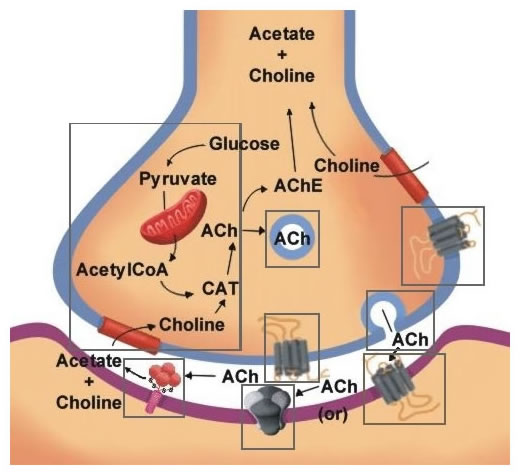
Figure 11.4 is a summary of the biological mechanisms involved in the synthesis, storage secretion, receptor interaction and termination of acetylcholine. Click on the region of the cell describing these processes to learn more nearly each i.
 |
| Figure xi.4 |
Click on the blocks marked (to a higher place) to see details, or cull from the list below.
- Synthesis of Acetylcholine
- Storage of Acetylcholine
- Release of Acetylcholine
- Acetylcholine Receptors
- Nicotinic
- Muscarinic
- Termination of Acetylcholine Activity
xi.6 Synthesis of ACh
| Figure eleven.5 |
Choline acetyltransferase (CAT): Every bit shown in Effigy 11.v, ACh is synthesized past a single footstep reaction catalyzed by the biosynthetic enzyme choline acetyltransferase. As is the case for all nerve terminal proteins, Cat is produced in the cholinergic cell torso and transported down the axon to the nervus endings. Both CAT and ACh may exist institute throughout the neuron, merely their highest concentration is in axon terminals. The presence of CAT is the "marker" that a neuron is cholinergic, merely cholinergic neurons contain True cat.
The rate-limiting steps in ACh synthesis are the availability of choline and acetyl-CoA. During increased neuronal activity the availability of acetyl-CoA from the mitochondria is upregulated as is the uptake of choline into the nervus ending from the synaptic cleft. Caii+ appears to be involved in both of these regulatory mechanisms. Every bit will be described afterward, the inactivation of ACh is converted by metabolism to choline and acetic acrid. Consequently much of the choline used for ACh synthesis comes from the recycling of choline from metabolized ACh. Another source is the breakup of the phospholipid, phosphatidylcholine. I of the strategies to increase ACh neurotransmission is the administration of choline in the diet. Nevertheless, this has not been constructive, probably because the administration of choline does not increase the availability of choline in the CNS.
11.7 Storage of ACh
The majority of the ACh in nerve endings is contained in clear (as viewed in the electron microscope) 100 um vesicles. A small amount is also free in the cytosol. Vesicle-leap ACh is non accessible to degradation by acetylcholinesterase (see below).
The uptake of ACh into storage vesicle occurs through an energy-dependent pump that acidifies the vesicle. The acidified vesicle and then uses a vesicular ACh transporter (VAChT) to exchange protons for ACh molecules. No useful pharmacological agents are bachelor to modify cholinergic function through interaction with the storage of ACh.
Interestingly, the cistron for VAChT is independent on the first intron of the choline acetyltransferase gene. This proximity implies the 2 of import cholinergic proteins are probably regulated coordinately.
| Figure xi.6 |
11.8 Release of ACh
The release of ACh occurs through Ca2+ stimulated docking, fusion, and fission of the vesicle with the nervus terminal membrane, as discussed previously.
You volition remember that the miniature endplate potentials and the quantal release in response to activeness potentials at the neuromuscular junction are due to the release of packets of ACh from individual storage vesicles (Chapter 5). Many toxins are known that interfere with these processes and are effective in preventing ACh secretion. The examples in Effigy 11.6 shows botulinum toxin inhibition and black widow spider venom (BWSV) stimulation of ACh release.
| Figure 11.7 |
11.9 ACh Receptors
At that place are 2 wide classes of cholinergic receptors: nicotinic and muscarinic. This classification is based on 2 chemic agents that mimic the effects of ACh at the receptor site nicotine and muscarine.
Tabular array I summarizes some of the backdrop of nicotinic and muscarinic receptors.
| Table I | |
| Nicotinic | Muscarinic |
| Bind nicotine | Bind muscarine |
| Blocked by curare (tubocurarine) | Blocked past atropine |
| Linked to ionic channels | Linked to 2nd messenger systems through G proteins (see below) |
| Response is brief and fast | Response is slow and prolonged |
| Located at neuromuscular junctions, autonomic ganglia, and to a small extent in the CNS | Found on myocardial muscle, certain smooth musculus, and in discrete CNS regions |
| Mediate excitation in target cells | Mediate inhibition and excitation in target cells |
| Postsynaptic | Both pre- and postsynaptic |
11.ten The Nicotinic Receptor is an Ion Channel
 |
| Effigy eleven.8 |
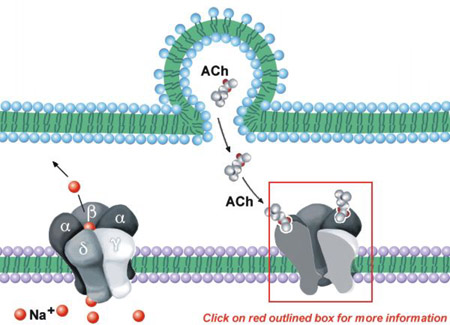
Equally indicated in Table I, nicotinic receptors are located at the NMJ, autonomic ganglia and sparsely in the CNS.
The NMJ nicotinic ACh receptor consists of five polypeptide subunits: two α subunits and 1 each of β, δ, and γ (run across Effigy xi.8). A funnel-shaped internal ion channel is surrounded by the 5 subunits. The bounden surface of the receptor appears to exist primarily on the α subunits, near the outer surface of the molecule. The subunits contain recognition sites for agonists, reversible antagonists, and α -toxins (cobra α-toxin and α -bungarotoxin).
Whereas the NMJ nicotinic receptor is composed of four different species of subunit (2 α, β, γ, δ), the neuronal nicotinic receptor also is composed of only two subunit types (two α and iii β).
11.11 The Muscarinic Receptor is Coupled to Thousand-Proteins
| Figure 11.ix |
Muscarinic receptors, classified equally G protein coupled receptors (GPCR), are located at parasympathetic autonomically innervated visceral organs, on the sweat glands and piloerector muscles and both post-synaptically and pre-synaptically in the CNS (see Table I). The muscarinic receptor is composed of a unmarried polypeptide. Seven regions of the polypeptide are made up of 20-25 amino acids arranged in an α helix. Because each of these regions of the protein is markedly hydrophobic, they span the cell membrane seven times as depicted in Effigy 11.9. The fifth internal loop and the carboxyl-concluding tail of the polypeptide receptor are believed to be the site of the interaction of the muscarinic receptor with G proteins (see right). The site of agonist binding is a circular pocket formed past the upper portions of the seven membrane-spanning regions.
ACh has excitatory actions at the neuromuscular junction, at autonomic ganglion, at certain glandular tissues and in the CNS. Information technology has inhibitory actions at certain shine muscles and at cardiac muscle.
| Effigy 11.10 |
The biochemical responses to stimulation of muscarinic receptor involve the receptor occupancy causing an contradistinct conformation of an associated GTP-binding protein (K protein). G poly peptide is made up of the three subunits α, β and γ . In response to the altered conformation of the muscarinic receptor, the a subunit of the G poly peptide releases bound guanosine diphosphate (GDP) and simultaneously binds guanosine triphosphate (GTP). The binding of GTP "activates" the Thousand poly peptide, allowing dissociation of the α subunit from the trimeric complex and for it to interact with effector systems to mediate specific responses. An inherent GTPase catalytic activity of the G protein hydrolyzes the GTP back to GDP. This hydrolysis terminates the action of the G poly peptide. The rate of hydrolysis of the GTP thus dictates the length of time the G protein remains activated.
The responses mediated by muscarinic receptors through 1000 proteins include:
| Effigy eleven.11 |
Inhibition of Adenylate Cyclase: The muscarinic receptor, through interaction with an inhibitory GTP-binding protein, acts to inhibit adenylyl cyclase. Reduced cAMP production leads to reduced activation of military camp-dependent poly peptide kinase, reduced heart rate, and contraction force.
| Figure eleven.12a | Figure eleven.12b |
Stimulation of Phospholipase C: The muscarinic receptor activates phosphoinositide-specific phospholipase C (PLC β ) through interaction with a GTP-binding protein. As shown in Figure xi.12a, the hydrolysis of phosphatidylinositol bisphosphate yields two 2d messengers; inositol trisphosphate (IP3) and diacylglycerol (DAG). The DAG activates protein kinase C (not shown). Cellular responses are influenced by PKC'south phosphorylation of target proteins. Equally shown in Effigy 11.12b, the IPiii diffuses to the smooth endoplasmic reticulum (ER) where it interacts with IP3 receptors to increase Ca2+ release from the intracellular storage site.
| Figure eleven.xiii |
Activation of One thousand+ Channels: In response to muscarinic cholinergic receptor stimulation, a GTP bounden protein also tin interact direct with K+ channels to increment K+ conductance, (Figure 11.xiii). This conductance increase increases the resting membrane potential in myocardial and other cell membranes leading to inhibition.
11.12 Termination of ACh Action
| Figure eleven.14 |
ACh binds simply briefly to the pre- or postsynaptic receptors. Post-obit dissociation from the receptor, the ACh is quickly hydrolyzed by the enzyme acetylcholinesterase (AChE) as shown in Figure 11.14. This enzyme has a very high catalysis charge per unit, 1 of the highest known in biology. Anguish is synthesized in the neuronal jail cell torso and distributed throughout the neuron by axoplasmic send. AChE exists equally alternatively spliced isoforms that vary in their subunit composition. The variation at the NMJ is a heteromeric protein composed of four subunits coupled to a collagen tail that anchors the multi-subunit enzyme to the cell membrane of the postsynaptic jail cell (Figure 11.14). This four-subunit course is held together by sulfhydryl bonds and the tail anchors the enzyme in the extracellular matrix at the NMJ. Other isoforms are homomeric and freely soluble in the cytoplasm of the presynaptic cell. AChE, unlike ChAT, is found in non-cholinergic neurons as well. In improver, other cholinesterases exist throughout the body, which are also able to metabolize acetylcholine. These are termed pseudocholinesterases.
Drugs that inhibit ACh breakdown are effective in altering cholinergic neurotransmission. In fact, the irreversible inhibition of AChE by isopropylfluoroesters are and so toxic that they can exist incompatible with life—inhibiting the muscles for respiration. This inhibition is produced because ACh molecules accumulate in the synaptic space, keep the receptors occupied, and crusade paralysis. Two notable examples are insecticides and the gases used in biological warfare. The mechanism of activeness of these irreversible inhibitors of AChE is that they carbamylate the Ache, rendering it inactive. The carbamylation inactivates both the acetyl and choline binding domains. A recently developed antitoxin to these inhibitors cleaves the nerve gas so that it will dissociate from the AChE.
In contrast to the irreversible inhibitors, the reversible Ache inhibitors are effective in transiently increasing the ACh level and are effective in diseases and conditions where an increased ACh level is desired. The clinically important compound, eserine (physostigmine), reversibly inhibits Anguish.
11.13 Physiology
Nicotinic receptor activation causes the opening of the channel formed past the receptor. This increases the Na+ move into the target cell, leading to depolarization and generation of the action potential. This rapidly developing change, termed a fast EPSP, is illustrated in Figures 4.3, and half-dozen.ii.
| Figure xi.fifteen |
Muscarinic receptor activation of postsynaptic cells tin be either excitatory or inhibitory and is always slow in onset and long in duration (Table I). Figure 11.16 and Figure 11.17 illustrate an excitatory and an inhibitory postsynaptic potential in the sympathetic ganglion. As described earlier, K protein activation underlies all deportment of the muscarinic receptors, thus accounting for their tedious onset.
| Effigy xi.16 | Effigy xi.17 | |
| Ho-hum EPSP and IPSP grade the sympathetic ganglion of the rat. | ||
11.xiv Behavior
The rapid nature of the synaptic manual mediated by the nicotinic receptor is consequent with its role at the NMJ and in the ganglion of the ANS. Little is known about the role of the nicotinic receptor office in CNS beliefs. Clearly, nicotine stimulation is related in some fashion to reinforcement, as indicated by the prevalence of nicotine addiction amidst humans.
Muscarinic receptors, in contrast, are of import mediators of behavior in the CNS. Ane example is their role in modulating motor control circuits in the basal ganglia. A 2nd example is their participation in learning and memory. The latter is inferred from ii types of observations: i) muscarinic antagonists are amnesic agents, and 2) deterioration of the cholinergic innervation of the neocortex is associated with memory loss in Alzheimer'south disease.
11.15 Clinical
Alzheimer'southward disease: A disease in which a marked deterioration occurs in the CNS, the hallmark of which is a progressive dementia. I of the characteristics of this disease is a marked decrease in ACh concentrations in the cerebral cortex and caudate nucleus.
Myasthenia gravis: A disease of the neuromuscular junction in which the receptors for ACh are destroyed through the actions of the patient's own antibodies.
Cholinergic Pharmacology: Numerous drugs are used clinically to collaborate with the cholinergic systems. Table II summarizes the major uses for cholinergic drugs.
11.16 Cholinergic Pharmacological Agents
| Tabular array Two Cholinergic Pharmacological Agents | ||
| Drug | Activity | Clinical Apply |
| Atropine (and other anticholinergics) | Blocks muscarinic receptors | Relaxes muscle in the eye causing the educatee to dilate. Used when the eye is inflamed and during eye examinations. |
| Slows the activity of the stomach and intestinal runway and reduces acid secretion. Therefore, used for tum cramps, diarrhea, diverticulitis, pancreatitis, bed wetting, motion sickness. | ||
| There has been some indication of this drug for Parkinson's disease. | ||
| Scopolamine | Blocks CNS muscarinic receptors | Used topically to prevent dizziness, nausea and other aspects of motion sickness. |
| Amantadine (Symmetrel) | Blocks muscarinic receptors | Antidyskinetics used to treat Parkinson'southward illness and the dyskinesia associated with antipsychotic drugs |
| Bethanechol | Mimics ACh | Used to treat urinary retention, and stimulate movement of intestinal tract. |
| Tacrine (Cognex) | Blocks ACh breakdown | Treat Alzheimer's illness |
| Eserine or physostigmine | Blocks ACh breakup | Reduces pressure in the eye and is used to care for glaucoma |
| Used to diagnose and treat myasthenia gravis | ||
Examination Your Cognition
- Question 1
- A
- B
- C
- D
- E
Which of the post-obit is effective in increasing the level of acetylcholine in the synapse or neuromuscular junction? (NOTE: There is more one correct answer.)
A. Increasing dietary acetyl coenzyme A
B. Increasing the production of acetyl coenzyme A
C. Increasing dietary choline
D. Increasing choline uptake
Due east. Inhibition of the enzyme, acetylcholinesterase
Which of the following is constructive in increasing the level of acetylcholine in the synapse or neuromuscular junction? (NOTE: There is more ane correct reply.)
A. Increasing dietary acetyl coenzyme A This answer is INCORRECT. The administration of treatments to enhance acetyl coenzyme A production is not effective in elevating acetylcholine neurotransmission.
B. Increasing the production of acetyl coenzyme A
C. Increasing dietary choline
D. Increasing choline uptake
E. Inhibition of the enzyme, acetylcholinesterase
Which of the following is effective in increasing the level of acetylcholine in the synapse or neuromuscular junction? (Notation: In that location is more than one right answer.)
A. Increasing dietary acetyl coenzyme A
B. Increasing the production of acetyl coenzyme A This reply is CORRECT! Although the administration of drugs to raise acetyl coenzyme A production are not constructive in elevating acetylcholine neurotransmission, cholinergic neurons increase their coenzyme A production equally a means of increasing acetylcholine availability for neurotransmission.
C. Increasing dietary choline
D. Increasing choline uptake
E. Inhibition of the enzyme, acetylcholinesterase
Which of the post-obit is effective in increasing the level of acetylcholine in the synapse or neuromuscular junction? (NOTE: There is more than than one correct answer.)
A. Increasing dietary acetyl coenzyme A
B. Increasing the production of acetyl coenzyme A
C. Increasing dietary choline This respond is Incorrect. Although choline availability to the cholinergic neurons is rate limiting in the synthesis of acetylcholine, studies in animals and humans point that the assistants of choline is ineffective in elevating cholinergic neurotransmission.
D. Increasing choline uptake
East. Inhibition of the enzyme, acetylcholinesterase
Which of the following is effective in increasing the level of acetylcholine in the synapse or neuromuscular junction? (Notation: At that place is more than one correct respond.)
A. Increasing dietary acetyl coenzyme A
B. Increasing the production of acetyl coenzyme A
C. Increasing dietary choline
D. Increasing choline uptake This answer is CORRECT! Although the dietary administration of choline is ineffective equally a means of increasing acetylcholine neurotransmission, cholinergic neurons increase their choline uptake equally a means of increasing the synthesis of acetylcholine for neurotransmission.
E. Inhibition of the enzyme, acetylcholinesterase
Which of the following is effective in increasing the level of acetylcholine in the synapse or neuromuscular junction? (NOTE: There is more than i correct answer.)
A. Increasing dietary acetyl coenzyme A
B. Increasing the production of acetyl coenzyme A
C. Increasing dietary choline
D. Increasing choline uptake
E. Inhibition of the enzyme, acetylcholinesterase This answer is Right!
Inhibitors of acetylcholinesterase are the near effective ways to elevate acetylcholine either at cholinergic neurons or at the neuromuscular junction. These drugs are used to care for Alzheimer'south disease, myasthenia gravis and in many other situations where the top of cholinergic neurotransmission is desired.

Donations to Neuroscience Online will help fund evolution of new features and content.
Source: https://nba.uth.tmc.edu/neuroscience/s1/chapter11.html
0 Response to "What Part of Ach Gets Recycles and Used by the Nerve Again?"
Post a Comment