Bill Clinton Defend Him Self in House of Representatives
| Impeachment of Bill Clinton | |
|---|---|
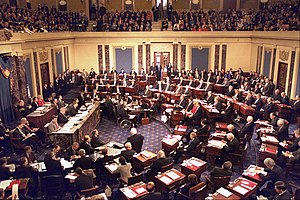 Flooring proceedings of the U.South. Senate during the trial of President Nib Clinton in 1999, Chief Justice William Rehnquist presiding | |
| Accused | Bill Clinton, President of the United states of america |
| Engagement | Dec xix, 1998 (1998-12-19) to February 12, 1999 (1999-02-12) |
| Result | Acquitted by the U.South. Senate, remained in office |
| Charges | Perjury (2), obstruction of justice, abuse of ability |
| Congressional votes | |
| Voting in the U.S. Business firm of Representatives | |
| Accusation | Perjury / grand jury |
| Votes in favor | 228 |
| Votes against | 206 |
| Result | Approved |
| Accusation | Perjury / Jones case |
| Votes in favor | 205 |
| Votes confronting | 229 |
| Upshot | Rejected |
| Accusation | Obstacle of justice |
| Votes in favor | 221 |
| Votes against | 212 |
| Event | Approved |
| Accusation | Corruption of power |
| Votes in favor | 148 |
| Votes against | 284 |
| Event | Rejected |
| Voting in the U.South. Senate | |
| Accusation | Article I – perjury / yard jury |
| Votes in favor | 45 "guilty" |
| Votes confronting | 55 "not guilty" |
| Upshot | Acquitted (67 "guilty" votes necessary for a conviction) |
| Allegation | Article II – obstruction of justice |
| Votes in favor | l "guilty" |
| Votes against | 50 "not guilty" |
| Issue | Acquitted (67 "guilty" votes necessary for a conviction) |
The impeachment of Pecker Clinton occurred when Bill Clinton, the 42nd president of the U.s., was impeached by the United States House of Representatives of the 105th United States Congress on December 19, 1998 for "high crimes and misdemeanors". The House adopted two articles of impeachment confronting Clinton, with the specific charges against Clinton being lying under adjuration and obstruction of justice. Two other articles had been considered, only were rejected past House vote.
Clinton's impeachment came after a formal House enquiry, which had been launched on October 8, 1998. The charges for which Clinton was impeached stemmed from a sexual harassment lawsuit filed against Clinton by Paula Jones and from Clinton's testimony denying that he had engaged in a sexual human relationship with White House intern Monica Lewinsky. The catalyst for the president's impeachment was the Starr Report, a September 1998 report prepared past Contained Counsel Ken Starr for the House Judiciary Committee.[1]
Clinton was the second American president to exist impeached (the showtime existence Andrew Johnson, who was impeached in 1868).[a]
The approved manufactures of impeachment would be submitted to the United States Senate on January 7, 1999. A trial in the Senate then began, with Primary Justice William Rehnquist presiding. On February 12, Clinton was acquitted on both counts as neither received the necessary ii-thirds majority vote of the senators present for conviction and removal from part—in this example 67. On Article One, 45 senators voted to convict while 55 voted for acquittal. On Article Two, 50 senators voted to captive while 50 voted for acquittal.[iii] Clinton remained in office for the residuum of his second term.[iv]
Background [edit]
In 1994, Paula Jones filed a lawsuit accusing Clinton of sexual harassment when he was governor of Arkansas.[5] Clinton attempted to delay a trial until subsequently he left role, but in May 1997 the Supreme Courtroom unanimously rejected Clinton'southward merits that the Constitution immunized him from civil lawsuits, and shortly thereafter the pre-trial discovery process commenced.[half-dozen]
Separate from this, in Jan 1994, Chaser General Janet Reno appointed Robert B. Fiske as an Independent counsel to investigate the Whitewater controversy.[seven] In Baronial of that twelvemonth, Ken Starr is appointed to replace Fiske in this office.[7]
In 1997, the first effort in Congress to offset an impeachment against Clinton was launched by Republican Congressman Bob Barr.[8]
Jones's attorneys wanted to prove Clinton had engaged in a design of behavior with women who supported her claims. In late 1997, Linda Tripp began secretly recording conversations with her friend Monica Lewinsky, a sometime intern and Department of Defense force employee. In those recordings, Lewinsky divulged that she had a sexual relationship with Clinton. Tripp shared this information with Jones's lawyers, who added Lewinsky to their witness list in December 1997. According to the Starr Report, a U.Southward. federal government study written by appointed Contained Counsel Ken Starr on his investigation of President Clinton, after Lewinsky appeared on the witness list Clinton began taking steps to conceal their relationship. Some of the steps he took included suggesting to Lewinsky that she file a false affidavit to misdirect the investigation, encouraging her to use comprehend stories, concealing gifts he had given her, and attempting to help her find gainful employment to try to influence her testimony.[ citation needed ]
In a January 17, 1998 sworn deposition, Clinton denied having a "sexual human relationship", "sexual affair", or "sexual relations" with Lewinsky.[9] His lawyer, Robert S. Bennett, stated with Clinton nowadays that Lewinsky's affidavit showed in that location was no sex in any manner, shape or form between Clinton and Lewinsky. The Starr Report states that the following day, Clinton "coached" his secretarial assistant Betty Currie into repeating his denials should she be called to prove.
After rumors of the scandal reached the news, Clinton publicly said, "I did not have sexual relations with that woman, Miss Lewinsky."[ten] But months afterward, Clinton admitted his relationship with Lewinsky was "incorrect" and "not appropriate". Lewinsky engaged in oral sex with Clinton several times.[11] [12]
The approximate in the Jones case after ruled the Lewinsky matter immaterial, and threw out the case in April 1998 on the grounds that Jones had failed to show whatsoever damages. Afterward Jones appealed, Clinton agreed in November 1998 to settle the case for $850,000 while still admitting no wrongdoing.[13]
The Starr Report was released to Congress on September ix, 1998 and to the public on September xi.[vii] [14] In the report, Starr argued that at that place were eleven possible grounds for impeachment of Clinton, including perjury, obstruction of justice, witness tampering, and corruption of ability. The report also detailed explicit and graphic details of the sexual human relationship between Clinton and Lewinsky.[seven] [15]
Independent counsel investigation [edit]
The charges arose from an investigation past Ken Starr, an Independent Counsel.[16] With the approval of United States Attorney General Janet Reno, Starr conducted a wide-ranging investigation of declared abuses, including the Whitewater controversy, the firing of White House travel agents, and the declared misuse of FBI files. On January 12, 1998, Linda Tripp, who had been working with Jones's lawyers, informed Starr that Lewinsky was preparing to commit perjury in the Jones case and had asked Tripp to practice the aforementioned. She also said Clinton's friend Vernon Jordan was assisting Lewinsky. Based on the connectedness to Jordan, who was under scrutiny in the Whitewater probe, Starr obtained blessing from Reno to expand his investigation into whether Lewinsky and others were breaking the police force.
A much-quoted statement from Clinton's grand jury testimony showed him questioning the precise use of the discussion "is". Contending his argument that "there'southward nothing going on between us" had been truthful because he had no ongoing relationship with Lewinsky at the time he was questioned, Clinton said, "Information technology depends on what the pregnant of the give-and-take 'is' is. If the—if he—if 'is' ways is and never has been, that is not—that is one thing. If it means there is none, that was a completely true statement."[17] Starr obtained further prove of inappropriate beliefs by seizing the reckoner hard drive and email records of Monica Lewinsky. Based on the president's alien testimony, Starr concluded that Clinton had committed perjury. Starr submitted his findings to Congress in a lengthy certificate, the Starr Report, which was released to the public via the Internet a few days later and included descriptions of encounters between Clinton and Lewinsky.[xviii] Starr was criticized by Democrats for spending $70 million on the investigation.[19] Critics of Starr also contend that his investigation was highly politicized because it regularly leaked tidbits of information to the press in violation of legal ethics, and because his report included lengthy descriptions which were humiliating and irrelevant to the legal example.[20] [21]
Firm of Representatives impeachment enquiry [edit]
On October 8, 1998, the United States Firm of Representatives voted to authorize a broad impeachment inquiry, thereby initiating the impeachment process.[22] The Republican controlled House of Representatives had decided this with a bipartisan vote of 258–176, with 31 Democrats joining Republicans.[23] Since Ken Starr had already completed an extensive investigation, the House Judiciary Committee conducted no investigations of its own into Clinton's alleged wrongdoing and held no serious impeachment-related hearings before the 1998 midterm elections.[ citation needed ] Impeachment was one of the major issues in those elections.[ citation needed ]
In the November 1998 House elections, the Democrats picked up 5 seats in the House, but the Republicans nonetheless maintained majority control. The results went against what Business firm Speaker Newt Gingrich predicted, who, before the ballot, had been reassured by private polling that Clinton's scandal would result in Republican gains of up to thirty Business firm seats. Shortly later on the elections, Gingrich, who had been 1 of the leading advocates for impeachment, announced he would resign from Congress as soon as he was able to observe somebody to fill his vacant seat;[24] [25] Gingrich fulfilled this pledge, and officially resigned from Congress on January 3, 1999.[26]
Impeachment proceedings were held during the mail service-election, "lame duck" session of the outgoing 105th United States Congress. Different the case of the 1974 impeachment process against Richard Nixon, the committee hearings were perfunctory but the floor contend in the whole Business firm was spirited on both sides. The Speaker-designate, Representative Bob Livingston, called by the Republican Party Conference to supersede Gingrich every bit House Speaker, announced the end of his candidacy for Speaker and his resignation from Congress from the floor of the House after his own marital infidelity came to light.[27] In the same speech, Livingston besides encouraged Clinton to resign. Clinton chose to remain in part and urged Livingston to reconsider his resignation.[28] Many other prominent Republican members of Congress (including Dan Burton,[27] Helen Chenoweth,[27] and Henry Hyde,[27] the chief House manager of Clinton'south trial in the Senate) had infidelities exposed about this fourth dimension, all of whom voted for impeachment. Publisher Larry Flynt offered a reward for such information, and many supporters of Clinton accused Republicans of hypocrisy.[27]
Impeachment by House of Representatives [edit]
December xviii, 1998: The House continued debate on four manufactures of impeachment against President Clinton for perjury, obstruction of justice and corruption of power.
On December 11, 1998, the House Judiciary Commission agreed to send three articles of impeachment to the total House for consideration. The vote on two manufactures, chiliad jury perjury and obstruction of justice, was 21–17, both along party lines. On the third, perjury in the Paula Jones case, the committee voted 20–xviii, with Republican Lindsey Graham joining with Democrats, in order to give President Clinton "the legal benefit of the doubtfulness".[29] The next twenty-four hours, December 12, the committee agreed to ship a quaternary and final article, for abuse of ability, to the full Firm by a 21–17 vote, once again, along party lines.[30]
Although proceedings were delayed due to the bombing of Iraq, on the passage of H. Res. 611, Clinton was impeached by the Business firm of Representatives on December 19, 1998, on grounds of perjury to a 1000 jury (commencement article, 228–206)[31] and obstruction of justice (third article, 221–212).[32] The 2 other articles were rejected, the count of perjury in the Jones instance (2nd article, 205–229)[33] and abuse of power (fourth article, 148–285).[34] Clinton thus became the second U.South. president to exist impeached; the first, Andrew Johnson, was impeached in 1868.[35] [36] The but other previous U.South. president to be the subject field of formal House impeachment proceedings was Richard Nixon in 1973–74. The Judiciary Committee agreed to a resolution containing three articles of impeachment in July 1974, merely Nixon resigned from function soon thereafter, before the House took up the resolution.[37]
| H. Res. 611 – Impeaching President Pecker Clinton December 19, 1998 | ||||
|---|---|---|---|---|
| Offset article (perjury / thousand jury) | Political party | Total votes[31] | ||
| Democratic | Republican | Independent | ||
Yea  Y Y | 00v | 223 | 000 | 228 |
| Nay | 200 | 00five | 001 | 206 |
| 2nd article (perjury / Jones example) | Political party | Full votes[33] | ||
| Democratic | Republican | Independent | ||
| Yea | 005 | 200 | 000 | 205 |
| Nay Y | 200 | 028 | 001 | 229 |
| Third article (obstruction of justice) | Party | Total votes[32] | ||
| Autonomous | Republican | Independent | ||
| Yea Y | 005 | 216 | 000 | 221 |
| Nay | 199 | 012 | 00i | 212 |
| Fourth article (abuse of ability) | Party | Total votes[34] | ||
| Autonomous | Republican | Independent | ||
| Yea | 00ane | 147 | 000 | 148 |
| Nay Y | 203 | 081 | 00i | 285 |
Five Democrats (Virgil Goode, Ralph Hall, Paul McHale, Charles Stenholm and Gene Taylor) voted in favor of iii of the four articles of impeachment, just only Taylor voted for the abuse of ability charge. Five Republicans (Amo Houghton, Peter King, Connie Morella, Chris Shays and Marker Souder) voted against the commencement perjury accuse. 8 more Republicans (Sherwood Boehlert, Michael Castle, Phil English, Nancy Johnson, Jay Kim, Jim Leach, John McHugh and Ralph Regula), but non Souder, voted against the obstruction charge. Twenty-eight Republicans voted against the second perjury charge, sending it to defeat, and eighty-one voted against the abuse of power charge.
Manufactures referred to Senate [edit]
Article I, charging Clinton with perjury, alleged in part that:
On August 17, 1998, William Jefferson Clinton swore to tell the truth, the whole truth, and goose egg simply the truth before a federal grand jury of the United States. Opposite to that oath, William Jefferson Clinton willfully provided perjurious, false and misleading testimony to the grand jury concerning i or more than of the following:
- the nature and details of his relationship with a subordinate regime employee;
- prior perjurious, false and misleading testimony he gave in a federal civil rights activity brought against him;
- prior faux and misleading statements he immune his attorney to make to a federal judge in that civil rights action; and
- his corrupt efforts to influence the testimony of witnesses and to impede the discovery of evidence in that civil rights activity.[38] [39]
Commodity II, charging Clinton with obstacle of justice declared in part that:
The ways used to implement this course of acquit or scheme included one or more than of the following acts:
- ...corruptly encouraged a witness in a Federal civil rights action brought against him to execute a sworn affidavit in that proceeding that he knew to be perjurious, false and misleading.
- ...corruptly encouraged a witness in a Federal ceremonious rights action brought against him to give perjurious, faux and misleading testimony if and when called to evidence personally in that proceeding.
- ...corruptly engaged in, encouraged, or supported a scheme to conceal evidence that had been subpoenaed in a Federal ceremonious rights action brought against him.
- ...intensified and succeeded in an endeavor to secure job assistance to a witness in a Federal civil rights activity brought confronting him in order to corruptly prevent the truthful testimony of that witness in that proceeding at a time when the truthful testimony of that witness would have been harmful to him.
- ...at his degradation in a Federal civil rights action brought confronting him, William Jefferson Clinton corruptly allowed his attorney to make false and misleading statements to a Federal guess characterizing an affidavit, in social club to foreclose questioning deemed relevant by the judge. Such simulated and misleading statements were subsequently acknowledged past his attorney in a communication to that approximate.
- ...related a false and misleading account of events relevant to a Federal civil rights action brought against him to a potential witness in that proceeding, in order to corruptly influence the testimony of that witness.
- ...fabricated fake and misleading statements to potential witnesses in a Federal grand jury proceeding in gild to corruptly influence the testimony of those witnesses. The false and misleading statements fabricated by William Jefferson Clinton were repeated by the witnesses to the 1000 jury, causing the thousand jury to receive false and misleading information.[38] [40]
Senate trial [edit]
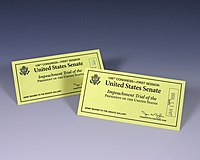
Tickets dated January xiv and 15, 1999, for President Bill Clinton's impeachment trial
Preparation [edit]
Between December xx and January 5, Republican and Democratic Senate leaders negotiated about the pending trial.[41] There was some word about the possibility of censuring Clinton instead of holding a trial.[41] Disagreement arose as to whether to call witnesses. This decision would ultimately not be made until after the opening arguments from the House impeachment managers and the White Firm defence team.[41] On January 5, Bulk Leader Trent Lott, a Republican, announced that the trial would start on January 7.[41]
Officers [edit]
Thirteen House Republicans from the Judiciary Committee served as "managers", the equivalent of prosecutors: Henry Hyde (chairman), Jim Sensenbrenner, Nib McCollum, George Gekas, Charles Canady, Steve Buyer, Ed Bryant, Steve Chabot, Bob Barr, Asa Hutchinson, Chris Cannon, James E. Rogan and Lindsey Graham.[42]
Clinton was defended by Cheryl Mills. Clinton's counsel staff included Charles Ruff, David Eastward. Kendall, Dale Bumpers, Bruce Lindsey, Nicole Seligman, Lanny A. Breuer and Gregory B. Craig.[43]
Process and schedule [edit]
The Senate trial began on January 7, 1999, with Primary Justice of the United States William Rehnquist presiding. The first twenty-four hours consisted of formal presentation of the charges against Clinton, and of Rehnquist swearing in all senators.[41]
A resolution on rules and procedure for the trial was adopted unanimously on the following twenty-four hour period;[44] notwithstanding, senators tabled the question of whether to call witnesses in the trial. The trial remained in recess while briefs were filed by the House (January 11) and Clinton (January 13).[45] [46]
The managers presented their case over three days, from Jan fourteen to 16, with discussion of the facts and background of the case; detailed cases for both articles of impeachment (including excerpts from videotaped one thousand jury testimony that Clinton had fabricated the previous Baronial); matters of interpretation and application of the laws governing perjury and obstruction of justice; and argument that the bear witness and precedents justified removal of the President from office by virtue of "willful, premeditated, deliberate corruption of the nation's system of justice through perjury and obstruction of justice".[47] The defense force presentation took identify January xix–21. Clinton'southward defense force counsel argued that Clinton'southward grand jury testimony had too many inconsistencies to be a clear case of perjury, that the investigation and impeachment had been tainted by partisan political bias, that the President'south blessing rating of more than 70 percent indicated his ability to govern had not been impaired past the scandal, and that the managers had ultimately presented "an unsubstantiated, coexisting case that does not see the constitutional standard to remove the President from office".[47] January 22 and 23 were devoted to questions from members of the Senate to the House managers and Clinton'due south defense counsel. Nether the rules, all questions (over 150) were to be written downward and given to Rehnquist to read to the party being questioned.[41] [48] [49]
On January 25, Senator Robert Byrd moved for dismissals of both articles of impeachment. On the post-obit day, Representative Bryant moved to phone call witnesses to the trial, a question the Senate had scrupulously avoided to that point. In both cases, the Senate voted to deliberate on the question in private session, rather than public, televised procedure. On January 27, the Senate voted on both motions in public session; the motion to dismiss failed on a well-nigh party line vote of 56–44, while the move to depose witnesses passed by the same margin. A day later, the Senate voted downwards motions to move direct to a vote on the articles of impeachment and to suppress videotaped depositions of the witnesses from public release, Senator Russ Feingold over again voting with the Republicans.
Over three days, February 1–3, Firm managers took videotaped airtight-door depositions from Monica Lewinsky, Clinton's friend Vernon Hashemite kingdom of jordan, and White House aide Sidney Blumenthal.[fifty] On February 4, however, the Senate voted 70–30 that excerpting these videotapes would suffice as testimony, rather than calling alive witnesses to announced at trial. The videos were played in the Senate on February vi, featuring 30 excerpts of Lewinsky discussing her affidavit in the Paula Jones case, the hiding of pocket-size gifts Clinton had given her, and his involvement in procurement of a job for Lewinsky.
On Feb 8, closing arguments were presented with each side allotted a 3-hour fourth dimension slot. On the President's behalf, White House Counsel Charles Ruff declared:
There is but one question before you, albeit a difficult i, ane that is a question of fact and law and constitutional theory. Would information technology put at run a risk the liberties of the people to retain the President in office? Putting aside partisan animus, if you can honestly say that it would not, that those liberties are prophylactic in his easily, so you must vote to acquit.[47]
Chief Prosecutor Henry Hyde countered:
A failure to captive will make the statement that lying nether oath, while unpleasant and to be avoided, is not all that serious... Nosotros accept reduced lying nether oath to a breach of etiquette, but only if you are the President... And now allow usa all have our place in history on the side of honor, and, oh, yes, permit right exist washed.[47]
Acquittal [edit]
On February ix, after voting against a public deliberation on the verdict, the Senate began closed-door deliberations instead. On February 12, the Senate emerged from its closed deliberations and voted on the manufactures of impeachment. A 2-thirds vote, 67 votes, would have been necessary to convict on either accuse and remove the President from office. The perjury charge was defeated with 45 votes for confidence and 55 confronting, and the obstruction of justice charge was defeated with 50 for confidence and 50 confronting.[3] [51] [52] Senator Arlen Specter voted "not proved"[b] for both charges,[53] which was considered past Chief Justice Rehnquist to constitute a vote of "not guilty". All 45 Democrats in the Senate voted "not guilty" on both charges, as did five Republicans; they were joined by 5 additional Republicans in voting "non guilty" on the perjury charge.[three] [51] [52]


| Articles of Impeachment, U.S. Senate judgement (67 "guilty" votes necessary for a confidence) | |||
|---|---|---|---|
| Article One[54] (perjury / grand jury) | Political party | Total votes | |
| Democratic | Republican | ||
| Guilty | 00 | 45 | 45 |
| Non guilty Y | 45 | 10 | 55 |
| Article Two[55] (obstruction of justice) | Political party | Total votes | |
| Democratic | Republican | ||
| Guilty | 00 | fifty | 50 |
| Not guilty Y | 45 | 0five | 50 |
Subsequent events [edit]
Contempt of courtroom citation [edit]
In April 1999, about two months after being acquitted by the Senate, Clinton was cited past federal District Judge Susan Webber Wright for civil antipathy of court for his "willful failure" to obey her orders to evidence truthfully in the Paula Jones sexual harassment lawsuit. For this, Clinton was assessed a $90,000 fine and the matter was referred to the Arkansas Supreme Court to encounter if disciplinary action would exist appropriate.[56]
Regarding Clinton's January 17, 1998, deposition where he was placed under adjuration, Webber Wright wrote:
Simply put, the president's deposition testimony regarding whether he had ever been alone with Ms. (Monica) Lewinsky was intentionally imitation, and his statements regarding whether he had ever engaged in sexual relations with Ms. Lewinsky likewise were intentionally false.[56]
On the day before leaving role on January 20, 2001, Clinton, in what amounted to a plea deal, agreed to a five-year suspension of his Arkansas law license and to pay a $25,000 fine as part of an understanding with independent counsel Robert Ray to stop the investigation without the filing of whatever criminal charges for perjury or obstruction of justice.[57] [58] Clinton was automatically suspended from the United States Supreme Court bar every bit a result of his law license suspension. However, every bit is customary, he was allowed 40 days to appeal the otherwise automatic disbarment. Clinton resigned from the Supreme Courtroom bar during the 40-day appeals catamenia.[59]
Civil settlement with Paula Jones [edit]
Eventually, the court dismissed the Paula Jones harassment lawsuit, earlier trial, on the grounds that Jones failed to demonstrate whatever damages. However, while the dismissal was on appeal, Clinton entered into an out-of-court settlement by agreeing to pay Jones $850,000.[threescore] [61]
Political ramifications [edit]

Opponents of Clinton'due south impeachment demonstrating outside the Capitol in December 1998
Polls conducted during 1998 and early 1999 showed that only about one-tertiary of Americans supported Clinton's impeachment or conviction. However, ane year afterwards, when it was clear that impeachment would not pb to the ousting of the President, half of Americans said in a CNN/USA Today/Gallup poll that they supported impeachment, 57% approved of the Senate's determination to continue him in function, and two-thirds of those polled said the impeachment was harmful to the country.[62]
While Clinton'due south task approving rating rose during the Clinton–Lewinsky scandal and subsequent impeachment, his poll numbers with regard to questions of honesty, integrity and moral grapheme declined.[63] Equally a result, "moral character" and "honesty" weighed heavily in the side by side presidential election. According to The Daily Princetonian, later on the 2000 presidential election, "post-election polls found that, in the wake of Clinton-era scandals, the unmarried most significant reason people voted for Bush was for his moral character."[64] [65] [66] According to an analysis of the ballot by Stanford Academy:
A more political explanation is the conventionalities in Gore campaign circles that disapproval of President Clinton's personal beliefs was a serious threat to the vice president'due south prospects. Going into the election the one negative element in the public'southward perception of the state of the nation was the belief that the country was morally on the wrong rail, whatever the state of the economy or world affairs. According to some insiders, anything done to raise the association between Gore and Clinton would have produced a net loss of support—the impact of Clinton's personal negatives would outweigh the positive bear on of his job performance on support for Gore. Thus, hypothesis four suggests that a previously unexamined variable played a major office in 2000—the retiring president'southward personal approval.[67]
The Stanford analysis, however, presented different theories and mainly argued that Gore had lost considering he decided to distance himself from Clinton during the campaign. The writers of information technology concluded:[67]
We observe that Gore's oft-criticized personality was not a cause of his nether-performance. Rather, the major cause was his failure to receive a historically normal amount of credit for the performance of the Clinton administration... [and] failure to get normal credit reflected Gore's peculiar campaign which in plough reflected fear of association with Clinton'south behavior.[67]
Co-ordinate to the America's Future Foundation:
In the wake of the Clinton scandals, independents warmed to Bush'southward hope to 'restore accolade and nobility to the White House'. Co-ordinate to Voter News Service, the personal quality that mattered well-nigh to voters was 'honesty'. Voters who chose 'honesty' preferred Bush-league over Gore past over a margin of 5 to 1. Forty iv percentage of Americans said the Clinton scandals were important to their vote. Of these, Bush-league reeled in three out of every four.[68]
Political commentators take argued that Gore'due south refusal to have Clinton campaign with him was a bigger liability to Gore than Clinton'south scandals.[67] [69] [70] [71] [72] The 2000 U.S. Congressional election too saw the Democrats proceeds more seats in Congress.[73] Equally a result of this proceeds, control of the Senate was split 50–fifty between both parties,[74] and Democrats would gain control over the Senate subsequently Republican Senator Jim Jeffords defected from his political party in early 2001 and agreed to caucus with the Democrats.[75]
Al Gore reportedly confronted Clinton afterwards the ballot, and "tried to explain that keeping Clinton under wraps [during the campaign] was a rational response to polls showing swing voters were nonetheless mad as hell over the Year of Monica". Co-ordinate to the AP, "during the one-on-one meeting at the White Business firm, which lasted more than than an hour, Gore used uncommonly blunt language to tell Clinton that his sex scandal and low personal approval ratings were a hurdle he could not surmount in his campaign... [with] the core of the dispute was Clinton's lies to Gore and the nation near his affair with White House intern Monica Lewinsky."[76] [77] [78] Clinton, yet, was unconvinced by Gore'southward argument and insisted to Gore that he would accept won the election if he had embraced the assistants and its good economic record.[76] [77] [78]
Partial retraction from Starr [edit]
In January 2020, while testifying as a defence force lawyer for U.Southward. President Donald Trump during his offset Senate impeachment trial, Starr himself would retract some of the allegations he fabricated to justify Clinton's impeachment.[79] Slate announcer Jeremy Stahl pointed out that as he was urging the Senate not to remove Trump every bit president, Starr contradicted various arguments he used in 1998 to justify Clinton's impeachment.[79] In defending Trump, Starr also claimed he was wrong to have called for impeachment against Clinton for abuse of executive privilege and efforts to obstruct Congress, and stated that the House Judiciary Committee was right in 1998 to have rejected one of the planks for impeachment he had advocated for.[79] He too invoked a 1999 Hofstra Law Review article by Yale police professor Akhil Amar, who argued that the Clinton impeachment proved just how impeachment and removal causes "grave disruption" to a national election.[79]
See also [edit]
- Impeachment of Andrew Johnson
- Impeachment process against Richard Nixon
- First impeachment of Donald Trump
- Second impeachment of Donald Trump
- List of federal political scandals in the United States
- List of federal political sex scandals in the United States
- 2nd-term curse
- Sexual misconduct allegations against Bill Clinton
Notes [edit]
- ^ Prior to Bill Clinton, the only other U.South. president aside from Andrew Johnson to exist the subject of formal Firm impeachment proceedings was Richard Nixon in 1973–74, only he resigned from the presidency on August 9, 1974, earlier the Business firm voted on his impeachment.[2]
- ^ A verdict used in Scots constabulary. It was recorded as a "not guilty" vote.
References [edit]
- ^ Drinking glass, Andrew (October 8, 2017). "Business firm votes to impeach Clinton, Oct. 8, 1998". Politico. Archived from the original on September 28, 2020. Retrieved June 12, 2019.
- ^ "Firm begins impeachment of Nixon". history.com. A&E Tv set Networks. Feb 26, 2022 [Published November 24, 2009]. Retrieved June 12, 2019.
- ^ a b c Baker, Peter (Feb 13, 1999). "The Senate Acquits President Clinton". The Washington Post. The Washington Post Co. Archived from the original on November ten, 2013. Retrieved December 4, 2013.
- ^ Riley, Russell L. (October 4, 2016). "Beak Clinton: Domestic Affairs". millercenter.org. Charlottesville, Virginia: The Miller Center, Academy of Virginia. Archived from the original on September 28, 2020. Retrieved October 3, 2019.
- ^ "Clinton v. Jones Timeline". The Washington Post. July 4, 1997. Archived from the original on February xx, 2018. Retrieved December 15, 2019.
- ^ "The Starr Report Narrative Pt. VII". The Washington Post. May 1997. Archived from the original on November xix, 2019. Retrieved December fifteen, 2019.
- ^ a b c d "Clinton impeachment timeline". the Guardian. November 18, 1998. Retrieved March 1, 2021.
- ^ Pace, David (November half dozen, 1997). "17 in House seek probe to impeach president". Newspapers.com. The Record. The Associated Press. Retrieved March four, 2021.
- ^ Starr, Kenneth. "The Starr Report Pt. XIV: The Deposition and Later". The Washington Mail service. Archived from the original on Dec 20, 2019. Retrieved December eighteen, 2019.
- ^ "What Clinton Said". The Washington Post. September 2, 1998. Archived from the original on February five, 2012. Retrieved May v, 2010.
- ^ "The Stained Blue Dress that Most Lost a Presidency". Academy of Missouri-Kansas School of Law. Archived from the original on July 3, 2008. Retrieved July 10, 2008.
- ^ Ross, Brian (March 19, 1998). "Hillary at White Business firm on 'Stained Blue Clothes' Day—Schules Reviewed past ABC Show Hillary May Accept Been in the White Business firm When the Fateful Act Was Committed". ABC News. Archived from the original on June 19, 2008. Retrieved July 10, 2008.
- ^ Baker, Peter (November 14, 1998). "Clinton Settles Paula Jones Lawsuit for $850,000". The Washington Mail service. Archived from the original on September 29, 2011. Retrieved June 3, 2018.
- ^ "Starr's study at a glance - September eleven, 1998". www.cnn.com. CNN. AllPolitics. September 11, 1998. Retrieved March 1, 2021.
- ^ "Explosive Starr report outlines instance for impeachment - September 11, 1998". www.cnn.com. CNN. AllPolitics. September xi, 1998. Retrieved March 1, 2021.
- ^ Erskine, Daniel H. (January 1, 2008). "The Trial of Queen Caroline and the Impeachment of President Clinton: Constabulary As a Weapon for Political Reform". Washington University Global Studies Law Review. 7 (1): 1–33. ISSN 1546-6981. Archived from the original on September 28, 2020. Retrieved December 6, 2019.
- ^ "Starr Report: Narrative". Nature of President Clinton's Relationship with Monica Lewinsky. Washington, D.C.: U.Southward. Government Printing Role. May xix, 2004. Archived from the original on December 3, 2000. Retrieved May 9, 2009.
- ^ "Starr report puts Internet into overdrive". CNN. September 12, 1998. Archived from the original on September thirteen, 2007. Retrieved May 23, 2011.
- ^ "Study ends affiliate of Clinton era". Archived from the original on September 28, 2020. Retrieved Jan 13, 2020.
- ^ "News leaks prompt lawyer to seek sanctions against Starr'southward Role". Thefreelibrary.com. Archived from the original on Dec 28, 2011. Retrieved May 23, 2011.
- ^ Palermo, Joseph A. (March 28, 2008). "The Starr Report: How To Impeach A President (Repeat)". Huffington Post. Archived from the original on February 14, 2008. Retrieved May 23, 2011.
- ^ "President Clinton impeached". history.com. A&Due east Tv Networks. January 13, 2022 [November 24, 2009]. Retrieved February 27, 2021.
- ^ "Firm approves impeachment inquiry". CNN. Oct 8, 1998. Archived from the original on September 28, 2020. Retrieved December 5, 2019.
- ^ Gibbs, Nancy; Duffy, Michael (November xvi, 1998). "Fall Of The House Of Newt". Time. Archived from the original on Baronial 21, 2010. Retrieved May 5, 2010. (subscription required)
- ^ Tapper, Jake (March nine, 2007). "Gingrich Admits to Affair During Clinton Impeachment". ABC News. Archived from the original on February 28, 2012. Retrieved May 23, 2011.
- ^ "Special election set to supplant Gingrich". Ocala Star-Banner. Jan five, 1999. Archived from the original on Jan xiv, 2021. Retrieved October 22, 2020 – via Google News archive.
- ^ a b c d e Kurtz, Howard, "Larry Flynt, Investigative Pornographer" Archived May 18, 2018, at the Wayback Machine, The Washington Post, December 19, 1998. Page C01. Retrieved 21-June-2010.
- ^ Karl, Jonathan (December 19, 1998). "Livingston bows out of the speakership". All Politics. CNN. Associated Press. Archived from the original on March xiii, 2007. Retrieved May ix, 2009.
- ^ "Judiciary approves three articles of impeachment". CNN. Dec eleven, 1998. Retrieved December 13, 2019.
- ^ "Judiciary Commission wraps upwards case against Clinton". CNN. Dec 12, 1998. Retrieved December 13, 2019.
- ^ a b Miller, Lorraine C. (December 19, 1998). "Final vote results for roll call 543". Office of the Clerk. Archived from the original on January half dozen, 2010. Retrieved April twenty, 2010.
- ^ a b Miller, Lorraine C. (December 19, 1998). "Concluding vote results for roll call 545". Part of the Clerk. Archived from the original on March 2, 2010. Retrieved April 20, 2010.
- ^ a b Miller, Lorraine C. (December 19, 1998). "Terminal vote results for roll call 544". Office of the Clerk. Archived from the original on March 2, 2010. Retrieved Apr 20, 2010.
- ^ a b Miller, Lorraine C. (December 19, 1998). "Final vote results for whorl phone call 546". Office of the Clerk. Archived from the original on March 2, 2010. Retrieved April 20, 2010.
- ^ Silverstein, Jason (November xv, 2019). "Impeached presidents: What take presidents been impeached for? Hither are the articles for Neb Clinton, Richard Nixon and Andrew Johnson". CBS News . Retrieved December 5, 2019.
- ^ Roos, David (November i, 2019). "How Many US Presidents Have Faced Impeachment?". history.com. A&E Tv set Networks. Retrieved Nov 12, 2019.
- ^
 This article incorporates public domain material from the Congressional Research Service document: Stephen W. Stathis and David C. Huckabee. "Congressional Resolutions on Presidential Impeachment: A Historical Overview" (PDF) . Retrieved December 23, 2019. – via University of N Texas Libraries, Digital Library, UNT Libraries Government Documents Department.
 - ^ a b This article incorporates public domain material from the United States Business firm of Representatives document: "A History of the Commission on the Judiciary 1813–2006, Department 2–Jurisdictions History of the Judiciary Committee: Impeachment" (PDF) . Retrieved December 23, 2019. (H. Doc. 109-153)
- ^ Text of Article I Archived December xvi, 2017, at the Wayback Machine Washington Post Dec 20, 1998
- ^ Text of Article IIII Archived December xvi, 2017, at the Wayback Machine Washington Mail service December twenty, 1998
- ^ a b c d e f Wire, Sarah D. (Jan 16, 2020). "A look back at how Clinton'south impeachment trial unfolded". Los Angeles Times . Retrieved February 27, 2021.
- ^ "Prosecution Who's Who". Washington Mail. January 14, 1999. Retrieved February 28, 2021.
- ^ Defense Who's Who Archived June 17, 2017, at the Wayback Machine, The Washington Mail, January xix, 1999.
- ^ "Senate's Unanimous Understanding on How to Keep in Clinton Trial". The New York Times . Retrieved January 7, 2020.
- ^ "South.Res.sixteen - A resolution to provide for the issuance of a summons and for related procedures concerning the articles of impeachment against William Jefferson Clinton, President of the Us". Library of Congress. January 8, 1999. Retrieved Jan 7, 2020.
- ^ "White House Response to Trial Summons". The Washington Post. Archived from the original on August 17, 2000. Retrieved January 7, 2020.
- ^ a b c d "Impeachment: Bill Clinton". The History Identify. 2000. Archived from the original on May fourteen, 2010. Retrieved May xx, 2010.
- ^ "Senate Trial Transcripts". Washington Post. 1999. Retrieved February 27, 2021.
- ^ Swanson, Ian (January 28, 2020). "Senators ready for question time in impeachment trial". TheHill . Retrieved February 28, 2021.
- ^ Clines, Francis X. (February 3, 1999). "THE PRESIDENT'South TRIAL: THE OVERVIEW; Senators Come across Lewinsky Tape And Vernon Jordan Testifies". The New York Times . Retrieved February ix, 2020.
- ^ a b "How the senators voted on impeachment". CNN. February 12, 1999. Retrieved June 8, 2019.
- ^ a b Riley, Russell L. (Oct 4, 2016). "Bill Clinton: Domestic Affairs". Charlottesville, Virginia: Miller Center of Public Affairs, University of Virginia. Archived from the original on September 28, 2020. Retrieved June 12, 2019.
- ^ Specter, Arlen (Feb 12, 1999). "Senator Specter's airtight-door impeachment argument". CNN. Archived from the original on June 14, 2008. Retrieved March xiii, 2008.
My position in the matter is that the case has not been proved. I have gone dorsum to Scottish law where at that place are three verdicts: guilty, non guilty, and non proved. I am not prepared to say on this record that President Clinton is not guilty. But I am certainly not prepared to say that he is guilty. At that place are precedents for a Senator voting present. I promise that I will exist accorded the opportunity to vote non proved in this example.... But on this tape, the proofs are not present. Juries in criminal cases under the laws of Scotland take three possible verdicts: guilty, not guilty, not proved. Given the option in this trial, I doubtable that many Senators would choose 'not proved' instead of 'not guilty'.
That is my verdict: non proved. The President has dodged perjury by calculated evasion and poor interrogation. Obstruction of justice fails by gaps in the proofs. - ^ "U.S. Senate: U.S. Senate Gyre Call Votes 106th Congress - 1st Session". www.senate.gov. United States Senate. Retrieved February 28, 2021.
- ^ "U.S. Senate: U.Due south. Senate Roll Call Votes 106th Congress - 1st Session". www.senate.gov. Usa Senate. Retrieved Feb 28, 2021.
- ^ a b Clinton found in civil contempt for Jones testimony—Apr 12, 1999 Archived April 8, 2006, at the Wayback Machine
- ^ "Mr. Clinton's Terminal Bargain". The New York Times. January 20, 2001. Archived from the original on April 30, 2019. Retrieved May 15, 2019.
- ^ Neal v. Clinton , Civ. No. 2000-5677, Agreed Order of Discipline (Ark. Cir. Ct. January nineteen, 2001) ("Mr. Clinton admits and acknowledges... that his discovery responses interfered with the conduct of the Jones case past causing the court and counsel for the parties to expend unnecessary time, try, and resource...").
- ^ U.S. Supreme Courtroom Social club Archived January 22, 2002, at the Wayback Car. FindLaw. November thirteen, 2001.
- ^ "Jones v. Clinton finally settled". CNN. November thirteen, 1998. Archived from the original on Jan 13, 2010. Retrieved January 16, 2009.
- ^ "Clinton–Jones Settlement Text". CNN. November 13, 1998. Archived from the original on January 23, 2009. Retrieved Jan 13, 2009.
- ^ Keating Kingdom of the netherlands. "A year later Clinton impeachment, public approval grows of House determination" Archived March iii, 2008, at the Wayback Machine. CNN. December 16, 1999.
- ^ Broder, David S.; Morin, Richard (August 23, 1998). "American Voters See 2 Very Different Bill Clintons". The Washington Post. p. A1. Archived from the original on November 22, 2017. Retrieved Dec 5, 2017.
- ^ Arotsky, Deborah (May 7, 2004). "Singer authors book on the role of ethics in Bush presidency". The Daily Princetonian. Archived from the original on September 30, 2007.
- ^ Sachs, Stephen E. (Nov seven, 2000). "Of Candidates and Character". The Harvard Crimson. Archived from the original on December 31, 2006. Retrieved Apr 1, 2007.
- ^ Bishin, B. K.; Stevens, D.; Wilson, C. (Summer 2006). "Graphic symbol Counts?: Honesty and Fairness in Election 2000". Public Opinion Quarterly. 70 (2): 235–48. doi:10.1093/poq/nfj016. S2CID 145608174. Archived from the original on January 14, 2021. Retrieved January 22, 2020.
- ^ a b c d Fiorina, M.; Abrams, Southward.; Pope, J. (March 2003). "The 2000 U.S. Presidential Ballot: Can Retrospective Voting Be Saved?" (PDF). British Journal of Political Science. Cambridge Academy Press. 33 (2): 163–87. doi:10.1017/S0007123403000073. S2CID 154669354. Archived (PDF) from the original on Apr 7, 2008. Retrieved March 31, 2008.
- ^ Weiner, Todd J. (May xv, 2004). "Pattern for Victory". America's Hereafter Foundation. Archived from the original on Apr 2, 2015. Retrieved March 12, 2015.
- ^ "S/R 25: Gore's Defeat: Don't Arraign Nader (Marable)". Greens.org. Archived from the original on May x, 2011. Retrieved May 23, 2011.
- ^ Weisberg, Jacob (Nov 8, 2000). "Why Gore (Probably) Lost". Slate.com. Archived from the original on May 11, 2011. Retrieved May 23, 2011.
- ^ "An anatomy of 2000 Usa presidential ballot". Nigerdeltacongress.com. Archived from the original on May xvi, 2011. Retrieved May 23, 2011.
- ^ "Across the Recounts: Trends in the 2000 U.S. Presidential Election". Cairn.info. November 12, 2000. Archived from the original on May 10, 2011. Retrieved May 23, 2011.
- ^ Ripley, Amanda (Nov 20, 2000). "Election 2000: Tom Daschle, Senate Minority Leader: Partisan from the Prairie". Time. Archived from the original on November 22, 2010. Retrieved May v, 2010.
- ^ Schmitt, Eric (Nov nine, 2000). "THE 2000 Elections: The Senate; Democrats Gain Several Senate Seats, merely Republicans Retain Control". The New York Times. Archived from the original on May eighteen, 2013. Retrieved May 5, 2010.
- ^ "The Crist Switch: Superlative ten Political Defections". Fourth dimension. April 29, 2009. Archived from the original on May 3, 2010. Retrieved May v, 2010.
- ^ a b Carlson, Margaret (February 11, 2001). "When a Buddy Movie Goes Bad". Time. Archived from the original on June 4, 2008. Retrieved March 31, 2008.
- ^ a b "Clinton and Gore take it out". Associated Printing. February 8, 2001. Archived from the original on April 2, 2015.
- ^ a b Harris, John F. (February 7, 2001). "Blame divides Gore, Clinton". The Washington Post. Archived from the original on April ii, 2015. Retrieved March sixteen, 2015.
- ^ a b c d Stahl, Jeremy (Jan 27, 2020). "Ken Starr Argues There Are Likewise Many Impeachments These Days". Slate. Retrieved Oct 29, 2020.
External links [edit]
- "The Articles Explained". The Washington Post. (December xviii, 1998.) Archived August 16th, 2000 from the original link.
- "The Starr Report", The Washington Post (September xvi, 1998)
- "Impeachment of William Jefferson Clinton, President of the United States, Report of the Committee on the Judiciary, Business firm of Representatives, together with additional, minority, and dissenting views" (H. Rpt. 105-830) (440 pages), December 16, 1998
- "Dale Bumpers: Closing Defence Arguments—Impeachment Trial of William J. Clinton"
Source: https://en.wikipedia.org/wiki/Impeachment_of_Bill_Clinton
0 Response to "Bill Clinton Defend Him Self in House of Representatives"
Post a Comment